As the school year wraps up, districts shift focus from the classroom to the campus, launching major capital improvement efforts that shape the future of learning environments. At Seagoville PK-8, that work is already underway, with construction beginning on a transformative new campus for Dallas Independent School District. With more than 30 years of experience designing inspiring, high-performing spaces, KAI offers insight into one of our largest active projects with Dallas ISD, demonstrating how strategic master planning can elevate the student experience, protect environmental assets, and deliver a resilient, future-ready campus.
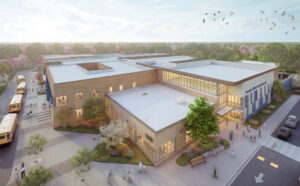 Seagoville PK–8 is a compelling precedent for how large, shared educational campuses can be strategically planned to support enrollment growth, operational efficiency, and continuity across grade levels. Located on a 100-acre site in southeast Dallas adjacent to one of the city’s last remaining post-oak reserves, the project demonstrates how thoughtful master planning balances educational needs, environmental stewardship, campus identity, and long-term adaptability within a complex, multi-school environment.
KAI partnered with Dallas ISD to move beyond a standalone facility and establish a campus-wide strategy, integrating a new 118,000-square-foot, two-story PK–8 school within an existing middle and high school campus. This approach addressed overcrowding across the Seagoville feeder pattern while creating a coordinated environment that supports shared resources, operational clarity, and future growth.
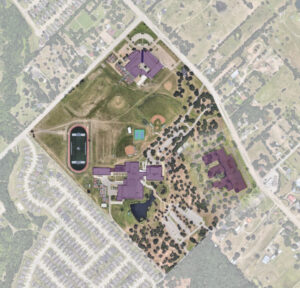 The masterplan organizes three distinct schools within a unified campus. Each maintains its own identity, security perimeter, and operations, while benefiting from shared infrastructure, amenities, and efficient land use. This framework supports continuity across grade levels and provides flexibility to adapt to evolving enrollment and program needs.
The site’s scale and environmental assets shape a connected student experience rooted in place. Educational walking trails, outdoor learning environments, and a reactivated pond extend learning beyond the classroom. Developed with community partners, these elements support hands-on exploration of ecosystems, native habitats, and stormwater processes while reinforcing the campus’s connection to one of Dallas’ most significant natural resources.
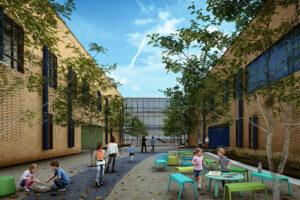 Balancing development with preservation was a critical driver. Building placement minimizes impact to the existing tree canopy and sensitive ecological areas while maximizing campus functionality. Architecture reinforces this relationship through biophilic design, abundant daylight, outdoor courtyards, and a “treehouse” maker space overlooking the media center. The building’s vertical expression draws from the surrounding forest canopy, strengthening its connection to the landscape.
Operational planning and security were equally integral. Three independently operated schools function safely within a single campus through layered security strategies, controlled access points, separated circulation, and clearly defined zones. Measures include perimeter fencing, secured outdoor learning areas, protected vestibules, anti-intrusion glazing, and integrated surveillance systems.
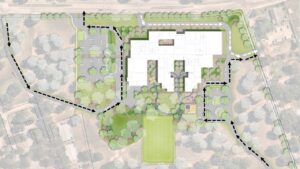 Site infrastructure supports both daily operations and long-term resilience. Separate parent circulation for elementary and secondary students, more than 3,700 linear feet of vehicle stacking, and reconfigured access points improve safety and reduce congestion while maintaining emergency access. Sustainable strategies, including underground stormwater detention and multi-use fields designed for significant rain events, reduce impact on municipal systems and enhance site performance.
Community engagement played a central role in shaping a campus that reflects the character and priorities of the Seagoville community. Positioned along a prominent corridor, the campus serves as a visible gateway that reinforces district investment and strengthens neighborhood identity.